
The Chemistry of Depth and the Turn Toward the Earth
Across contemporary painting, scenic production, concept illustration, and fine-art studios, a quiet material shift is taking place. Artists who once depended almost entirely on standardized acrylic dispersions and petroleum-derived resins are examining the raw ingredients beneath the finished tube. The attraction is not nostalgia alone. It is a search for greater optical complexity, more deliberate handling, and a studio workflow in which the maker controls the relationship between powder, binder, surface, and light. For artists developing a distinctive palette, natural earth pigments offer a direct route from geological material to visual decision.
Mass-manufactured acrylics remain useful, durable, and highly practical, but their consistency can also create a visual limitation. Uniform particles suspended in a polymer film often produce an even, sealed surface. That predictability is valuable for graphic blocking, rapid scenic coverage, and repeatable production, yet it can flatten visual hierarchy when every color reflects light in much the same manner. A mineral pigment behaves differently. Its fractured particles, variable transparency, and crystalline surfaces can break a passage into subtle zones of light, shadow, warmth, and coolness.
This article examines the material science behind that difference, while keeping the studio workflow firmly in view. The discussion moves from crystalline optics and geological permanence to dust control, sustainable cleanup, dispersion, and hand-mulling. The goal is not to romanticize every natural pigment or dismiss synthetic chemistry, but to give working artists a precise framework for deciding when raw mineral color can deepen the image and when its limitations must be managed.
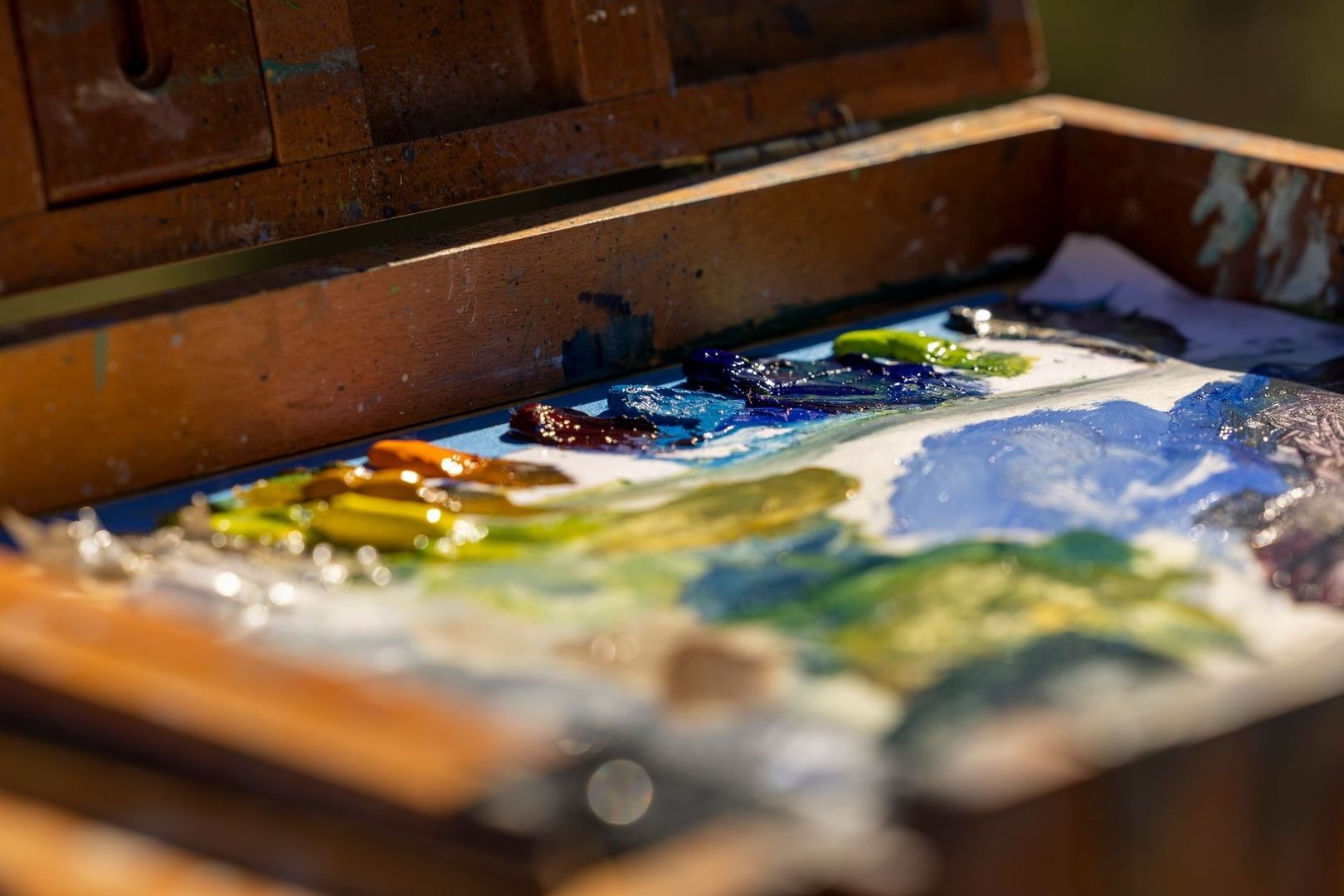
Optics of the Crystal Grid versus Plastic Resins
Paint is fundamentally a composite material. Pigment supplies color and optical behavior, while the binder wets the particles, carries them onto the support, and forms the final film. In an acrylic emulsion, pigment particles are distributed through a water-based polymer system that coalesces as it dries. The resulting matrix can be exceptionally stable and convenient, but it tends to surround relatively uniform particles with a continuous plastic layer. This creates a controlled surface response, often with consistent opacity and predictable gloss.
Natural minerals introduce a less uniform optical field. Ochre, sienna, umber, terre verte, azurite, and lapis lazuli contain particles shaped by fracture, cleavage, weathering, and preparation. Each facet can redirect light differently. Some particles sit visibly on the surface, while others settle into the binder and create granulation. In water media, a wash may separate into warm and cool components as particle size and density guide movement. In oil, the same pigment can produce a dense, tactile film with a slower, more complex shift between reflected and absorbed light.
Research into pigment visualization commonly measures refractive, scattering, and absorption properties rather than treating color as a simple numerical swatch. A study in the AEM Journal, for example, used Kubelka-Munk optics to model multilayer mineral and plant pigments in Gongbi painting. The practical lesson is significant for production artists: color changes as a function of layer, dilution, surface, and scattering. A mineral passage can therefore carry narrative information before the viewer consciously identifies its hue.
| Material characteristic | Natural crystalline minerals | Synthetic organic or petrochemical systems |
|---|---|---|
| Particle form | Often irregular, fractured, and variable | Frequently engineered for consistent size and shape |
| Light behavior | Granulation, facet reflection, scattering, and chromatic separation | More uniform absorption and reflection within a polymer or organic film |
| Surface character | Can feel granular, earthy, matte, or mineral-rich | Often smooth, even, and predictable |
| Production advantage | Distinctive variation and optical vibration | Fast coverage, repeatability, and broad commercial availability |
| Primary limitation | Batch variation, weaker tinting strength, and demanding dispersion | Potentially flatter hierarchy and dependence on synthetic additives |
Neither category is universally superior. Synthetic iron oxides may provide excellent transparency and consistency, while a natural ochre may offer subdued granulation and a more layered surface. Even within one pigment family, formulation changes the result. Comparisons of natural and synthetic earth colors show that natural Yellow Ochre, Burnt Sienna, and Burnt Umber can behave differently from synthetic transparent oxides, especially in opacity and granulation. The professional approach is to test the material under the intended lighting, scale, binder, and support rather than relying on the name printed on the label.
Archival Permanence Across Geological Time
Natural mineral pigments are often associated with permanence because their color comes from chemically stable inorganic structures. Iron oxides in ochres, siennas, and umbers have endured through geological processes that would destroy many fugitive dyes. Lapis lazuli, when properly prepared, has also been valued historically for its durable blue. That history is meaningful, but it should not become an automatic guarantee. Purity, adulteration, particle preparation, binder compatibility, and the exact geological source all influence the finished paint.
Synthetic lake pigments and modern organic dyes require more careful evaluation. Some are remarkably lightfast, while others fade under ultraviolet exposure, strong production lighting, or prolonged daylight. Manufacturer ratings can also conceal practical weaknesses. Tests may use thick masstone applications even though the artist intends to use highly diluted washes. Independent long-term testing, including the work documented in this lightfastness testing guide, demonstrates why diluted applications and realistic exposure conditions matter.
ASTM ratings provide a useful common language, but they describe performance under a defined test protocol, not an eternal promise. Geological stability is a different category of evidence. A mineral that has remained chemically recognizable through immense spans of time has a strong starting point, yet the paint film itself still faces oxidation, binder yellowing, moisture, abrasion, and environmental pollutants. For collector work, document the pigment identity, source, binder, support, preparation date, and any stabilizer or additive used.
- Prefer documented natural iron oxides, ochres, siennas, and umbers for demanding earth-color passages.
- Test every unfamiliar mineral in both concentrated and diluted applications.
- Record pigment names, Color Index numbers, source locations, binder ratios, and batch variation.
- Use conservative lighting for finished work, especially when organic lakes, neon colors, or dyes are present.
- Do not confuse a natural origin with automatic safety or permanence. Verify the material and its intended use.
Availability is another archival concern. Natural earth pigments are geologically variable and increasingly difficult to source at industrial scale. As documented by Just Paint, synthetic iron oxides can offer more consistent color, finer grinding, and stronger tinting power as natural supplies contract. For studios serving productions with exact continuity requirements, synthetic alternatives may be sensible. For fine-art work where surface identity and geological variation are part of the visual language, ethical natural sourcing can justify the additional testing and cost.
Engineering a Non-Toxic Studio Grinding Station
A mineral-based workflow can reduce dependence on volatile solvents and petroleum resins, but “natural” must never be treated as a substitute for risk assessment. Dry pigment is a particulate hazard because inhalation depends on particle size, concentration, and duration. Some minerals may also contain naturally occurring contaminants, while titanium dioxide and mica require particular care in powder form. Obtain a current safety data sheet, identify the material before opening it, and follow the requirements of the shared facility.
The grinding station should be designed like a controlled production department, not an improvised corner of the studio. A frosted glass slab provides a nonporous, lightly textured working surface. A glass muller distributes pressure across the paste, while a stainless scraper helps gather material without shedding fibers or absorbing oil. Separate tools for oil, gum, wax, and experimental media prevent cross-contamination and make batch records more reliable.
- Use a properly fitted particulate respirator appropriate to the powder and local regulations.
- Mix dry pigments inside a local extraction hood or enclosed dust-control area whenever possible.
- Wear eye protection, disposable gloves, and a dedicated apron that does not travel into living areas.
- Keep powders closed, labeled, and stored away from food, ventilation intakes, and high-traffic paths.
- Clean with damp methods or a suitable vacuum equipped with effective filtration. Do not dry sweep.
- Collect pigment residue rather than sending concentrated powder into sinks or storm drains.
Water management deserves special attention in shared creative facilities. A rinse bucket can capture pigment solids before the relatively clear water is separated, settled, and handled according to local waste rules. Reusable cloths should be designated for studio cleanup and laundered with care, since ordinary washing can distribute pigment into wastewater. Sustainability also includes purchasing close to the point of use, reusing jars, selecting durable tools, and avoiding unnecessary packaging.
Non-toxic practice is a system rather than a product claim. A plant-based binder may reduce certain emissions, but it does not eliminate dust or guarantee compatibility with every support. Likewise, replacing solvent cleaning with soap and water only works when the residue is captured responsibly. A well-designed station protects the artist, the production team, the building, and the downstream water system.
Mastering the Dispersion Formula and Mulling Protocol
Hand-mulling begins with a simple principle: pigment must be thoroughly wetted, but the binder must not be added so quickly that it forms a slippery shell around dry agglomerations. Every mineral absorbs liquid differently. Fine ochre may require less oil than a porous earth, while a dense mineral may need extended working before it reaches a stable paste. The task is controlled dispersion, not brute-force pulverization. Excessive grinding can alter particle size and reduce the granulation or reflective character that makes the pigment useful.
Raw sienna and ochre are excellent training materials because they are forgiving, historically important, and visually responsive. In oil paint, walnut oil can produce a fluid, luminous mixture, while linseed oil offers a durable film with different drying and yellowing behavior. In water media, gum arabic provides the binder, but the finished mixture requires careful preservation because water-based handmade paints can spoil. Keep a written formula, including pigment mass, binder volume, grinding time, and observations after drying.
- Prepare the station. Clean the slab and muller, confirm the pigment identity, put on respiratory protection, and measure a small test quantity. Small batches reveal handling characteristics without wasting material.
- Make a dry mound. Place the pigment on the slab and form a shallow crater. Add only a few drops of binder to the center rather than flooding the entire pile.
- Incorporate gradually. Use the scraper to fold dry powder into the wet center. Continue until the mixture resembles a stiff paste with no visible dry islands.
- Mull in a figure-eight. Hold the muller with controlled, even pressure and work in overlapping figure-eight paths. This shears agglomerations and distributes binder while preserving the intrinsic crystal structure.
- Scrape and rotate. Gather the paste frequently, rotate the working area, and repeat. Uneven edges often contain the least-wetted pigment.
- Adjust in measured increments. Add binder drop by drop when the paste remains crumbly. If it becomes glossy, greasy, or fluid before the color is dispersed, too much binder has been introduced.
- Run a film test. Apply a thin stroke, a heavier stroke, and a diluted passage. Check flow, opacity, granulation, drying, adhesion, and flexibility after the film has cured.
The correct viscosity depends on the medium and the shot or artwork requirement. Oil paint for a detailed illustration may need a creamy, brush-responsive body, while a scenic glaze may require controlled flow across a large surface. A good mixture spreads without dragging, does not release dry powder when brushed, and does not separate into oil halos during rest. For gum solutions, the paint should rewet cleanly and remain responsive without turning into a brittle crust.
Diagnostic testing should continue after the paint leaves the slab. Place a swatch on the actual ground, compare it under neutral daylight and production lighting, and examine it at the intended viewing distance. Look for sinking-in, unexpected darkening, binder separation, chalkiness, cracking, or loss of granulation. Natural pigments may change markedly according to support texture and dilution, so a digital color reference is only a starting point.
Documented paintmaking turns experimentation into a repeatable studio asset. A batch card can include the pigment source, sieve or particle preparation, binder, ratio, mulling duration, storage container, drying observations, and final application. That record allows a scenic department to recreate a color, a concept artist to rebuild a signature mixture, and a fine-art studio to explain the material history of a finished work. The process is slower than opening a tube, but it gives the artist control over every visual variable that commercial uniformity tends to conceal.
Reclaiming Material Mastery in Modern Studio Practice
Preparing mineral paint changes more than the surface of the image. It changes the artist”s attention. Color becomes a sequence of decisions about geology, particle size, binder, pressure, drying, and light. That expanded awareness can sharpen visual storytelling, whether the goal is a weathered set wall, an atmospheric concept plate, or a collector-grade painting whose surface must reward close inspection.
The strongest path forward is neither blind rejection of synthetic materials nor unquestioning devotion to natural ones. Source minerals ethically, verify safety information, test archival behavior, and build a small documented palette before scaling production. Begin with raw sienna, yellow ochre, burnt sienna, umber, or another well-characterized earth, then compare the result against a commercial equivalent under the lighting conditions that matter. That first controlled trial can reveal a new level of material agency and help establish a visual signature that no standardized color chart can fully reproduce.